Gut Health Supplements for Dogs: Giving One Safely, Dose and Timing
Quick Answer: Dose and Timing
Give a canine-specific product at the dose printed for your dog's body-weight band, once a day, with a meal or straight after one, because food buffers stomach acid and slows the arrival of fermentable fibre. Start at the lowest dose in your band for five to seven days before moving up, and if the dog is on antibiotics, separate the two by several hours. Never substitute a human formula: the fibre in many of them is derived from garlic and onion, and sugar-free versions can contain xylitol, both of which are unsafe for dogs.
- Dose by weighed body weight — use that product's own band, never a scoop borrowed from another brand.
- With food, once daily, same time — consistency matters more than the hour you choose.
- Ask the vet before starting — essential for puppies, pregnant dogs, immunosuppressed dogs and any dog on medication.

Why a dog's gut is not a scaled-down human gut
The temptation, when you already take something yourself, is to assume the dog version is the same thing in a smaller quantity. It is not, and the differences are structural rather than cosmetic. A dog's digestive tract is proportionally shorter than a human's, transit is faster, stomach acid sits at a lower pH, and the resident bacterial community is a different mix of organisms living on a different diet. A fibre that ferments politely across a long human colon can arrive in a dog's shorter one still largely unfermented, and then do all its fermenting in a hurry.
That single fact explains most of what goes wrong when owners improvise. The dog is not intolerant and the product is not defective; the dose simply outran the gut's capacity to process it gradually. It also explains why canine products are formulated so differently: lower fibre loads, strains selected from canine sources rather than human or dairy ones, and carriers designed to survive being mixed into a bowl of food that will be inhaled in nine seconds.
There is a species-specific safety layer on top of that. Several of the everyday plants humans use as prebiotic sources — garlic, onion, leek, shallot — are members of the allium family and are toxic to dogs, in powder form as much as fresh. So the fibre a human might happily eat as a side dish is exactly the fibre that must not reach the dog. That is not a dosing nuance. It is a hard line, and it is the main reason the two product categories cannot be shared.
How the dose is actually set
Almost every canine digestive product doses by body-weight band, and almost none of them use the same bands or the same concentration. A scoop from one tub can carry several times the fibre or live-organism count of a scoop from another, which is why the only correct source for a dose is the label of the tub in front of you. If you have switched brands, throw away the old habit along with the old scoop.
Two things scale with weight and one thing does not. Fermentable fibre scales, because it is a bulk ingredient acting on a volume of colon. Palatability carriers scale, because they are simply filler. Live organism counts scale much less predictably, because colonisation is not a straightforward function of body mass, and manufacturers often use flatter bands for the bacterial component than for the fibre. This is why some products give a small dog and a large dog the same number of organisms but different amounts of powder.
Weigh the dog rather than estimating. Estimating rounds upward almost every time, and fibre is the ingredient least forgiving of generosity. Then start at the bottom of your band, not the middle, and stay there for five to seven days. The point of that week is diagnostic: you are learning whether the stool firms up, stays the same, or loosens. If you begin at the top of the band and something goes wrong, you have no idea whether a smaller dose would have been fine.
Shopping for yourself rather than the dog?
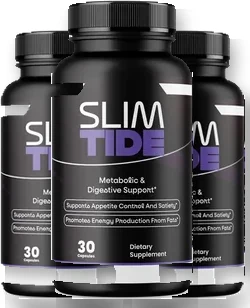
SlimTide is an adults-only daily capsule pairing chicory root inulin and potato resistant starch with three live strains. If you landed here while working out where to buy weight loss supplements safely, the official store is the only place with the current panel, the guarantee terms and the genuine article.
See the official storeTiming: with food, and well away from antibiotics
Give the dose with a meal or immediately after it. Food raises stomach pH for a while, which improves the proportion of live organisms that get through the stomach intact, and it slows gastric emptying so the fermentable fibre trickles into the intestine rather than arriving as a single slug. Both effects push in the direction of comfort. Mixing the powder into the first third of the bowl rather than sprinkling it on top also means the dose actually gets eaten, instead of being left as a dusty ring around a licked-clean bowl.
Once a day is enough for most products, and the specific hour matters far less than picking one and keeping it. Twice-daily products exist and their labels say so; splitting a once-daily dose in half without instruction is guesswork.
Antibiotics are the one timing question with a real answer. If your vet has prescribed a course and also suggested a digestive supplement alongside it, give them several hours apart rather than together, so the antibiotic is not landing directly on the organisms you have just introduced. Many vets suggest continuing the supplement for a stretch after the course finishes. Follow their instruction on that specifically, because it depends on the drug and the reason for it, and this is one situation where the veterinary evidence is stronger than for general use.
The other timing rule is around diet changes. If you are switching foods, do not also start a new supplement on the same day. Change one variable at a time, over about a week, or you will have no way of knowing which change produced the result you are looking at.
What the evidence says about gut health supplements for dogs
Here the honest answer is more useful than an enthusiastic one. Veterinary research into canine probiotics and prebiotics is a genuine field with published trials, but the findings are situation-specific and strain-specific rather than general. Where benefit has been reported, it attaches to a named strain at a named dose in a defined situation — most often acute digestive upset, antibiotic-associated loose stool, or stress-related changes such as kennelling. A product listing a species name with no strain identifier has not inherited any of that work, and a product studied for one situation has not been shown to do anything for another.
For the broad, non-specific purchase — a healthy dog, no symptoms, bought because gut health sounds worth supporting — the evidence is thin. That is not the same as saying it is useless, and well-characterised canine strains are generally well tolerated. It does mean nobody can honestly promise you an outcome, and any page that does has outrun its data. Supplements are not intended to diagnose, treat, cure or prevent any disease, in dogs or in people, and that framing is worth carrying into every claim you read.
| Situation | What is usually claimed | Strength of evidence | Practical note |
|---|---|---|---|
| Alongside a course of antibiotics | Fewer days of loose stool | The strongest of these, and still strain-specific | A veterinary decision; space the doses apart |
| Short-lived acute digestive upset | Faster return to normal stool | Moderate, for particular strains only | Vomiting, blood or lethargy means a vet, not a tub |
| Stress or kennelling | Steadier stool through a disruption | Limited | Start several days before the event, not on the day |
| Diet transition support | Smoother switch between foods | Limited | The slow transition is doing most of the work |
| General daily use in a healthy dog | “Gut health”, coat, immunity | Weak and largely indirect | Reasonable to try, unreasonable to expect much |
| Weight management | Appetite or body condition | Very weak in dogs | Measured meals and exercise are the real levers |
The question worth asking of any canine product is not “does it work?” but “which strain, at what dose, studied in which dogs, for which problem?” If the label cannot answer that, you are buying a category rather than a result.

Forms, and which one your dog will actually take
The best form is the one that gets into the dog every day without a negotiation. Owners who search for the best gut health supplement for dogs usually start from the ingredient panel and work forward; starting from the form your dog accepts and working backward tends to produce something that is still being used in a month.
| Form | Acceptance | Dose accuracy | Suits | Main drawback |
|---|---|---|---|---|
| Powder stirred into wet food | High | Good if the bowl is finished | Most dogs, most budgets | A half-eaten bowl is a half dose |
| Soft chew or treat | Very high | Good, one unit at a time | Fussy or suspicious dogs | Extra calories, and treated as a snack |
| Paste or gel syringe | Moderate | Best of the group | Short courses and refusers | Awkward daily, and messy |
| Capsule hidden in food | Low to moderate | Excellent | Dogs that swallow food whole | Frequently found and spat out |
| Sachet into dry kibble | Moderate | Poor without moisture | Dogs already on a topper | Powder sinks to the bottom, undosed |
| Plain live yoghurt or kefir | High | Not standardised at all | Occasional use only | Lactose, calories, unknown organism counts |
One practical note on chews. They are the easiest sell in the category and the easiest way to quietly add calories to a dog that is already carrying too many. If your dog is on a weight plan, subtract the chew from the daily food allowance rather than adding it on top.
Ingredients that are fine for you and not for your dog
This is the section worth reading twice, because it is where a well-meaning owner does harm. The following belong nowhere near a dog, regardless of what the human version of a product contains.
- Xylitol and birch sugar. Common in sugar-free human chews, gummies and powders, and seriously toxic to dogs at small amounts. This alone disqualifies sharing most sugar-free human supplements.
- Garlic, onion, leek and shallot, fresh or powdered. Excellent human inulin sources, unsafe for dogs. Check dried flavourings as carefully as fresh ingredients.
- Chocolate, cocoa and caffeine-bearing extracts such as green tea or guarana, which appear routinely in human metabolic formulas.
- Grape and raisin derivatives, including some fruit powders used as sweeteners or colours.
- Concentrated botanical extracts generally. Dose thresholds established in people say nothing useful about a ten-kilogram animal.
If you want to understand why human prebiotic products lean so heavily on alliums in the first place, our piece on where prebiotic fibre actually comes from in food lays out the sources, and makes the incompatibility obvious at a glance.
Keep tubs and jars where the dog cannot reach them. Palatable canine chews are designed to be attractive, which means a dog that gets into the container will keep eating, and a whole tub is a different event from a daily dose. If that happens, call your vet or an animal poison line rather than waiting to see.
What these products cannot do
Short, because the limits are the part most pages leave out.
- They do not diagnose, treat, cure or prevent any disease. Persistent diarrhoea, vomiting, blood, weight loss, lethargy or a painful abdomen belongs with a vet that week, not with a purchase.
- They do not replace a diagnosis. Chronic loose stool has a long list of causes, several of which get worse while an owner waits for a supplement to work.
- They do not fix a food that does not suit the dog. If the diet is the problem, the diet is the fix.
- They do not make a dog lose weight. Portion control and exercise do that, and the evidence for supplements in canine weight management is very weak.
- They are not standardised across brands. Two tubs described identically can share almost nothing, so a result with one says little about another.
- They are not for every dog. Immunosuppressed animals, dogs on chemotherapy and dogs with indwelling lines need a veterinary decision, because live organisms are not risk-free in those situations.
Choosing one without being sold to
Buy on the label rather than the ranking. Prefer products that name each strain in full rather than the species alone, that state the organism count at end of shelf life rather than at time of manufacture, and that disclose fibre in grams rather than burying it in a proprietary blend. Look for a batch number, an expiry date and storage instructions that match how you will actually keep it. In the United States, a product carrying the National Animal Supplement Council quality seal has at least submitted to an auditing programme, which is a low bar but a real one.
Ranked lists for the best dog gut health supplement UK shoppers see, and their equivalents everywhere else, are usually ordered by commission rather than by panel quality. Compare the ingredient tables side by side instead; it takes ten minutes and outperforms every list. And ignore the front of the pack entirely. “Advanced”, “clinical” and “veterinary strength” are marketing words with no regulatory meaning on a supplement.
Finally, the obvious point that keeps needing making: if you arrived here looking for something for yourself and ended up reading about dogs, the two shelves are not interchangeable in either direction. Our breakdown of the SlimTide fibre and strain panel goes through the adult human doses line by line, including the ones we think are modest, and we cover the equivalent age question for children in the piece on formats children will actually take. Neither belongs in a dog bowl.
Common questions
Are gut health supplements for dogs safe to give every day?
Canine-specific products from reputable makers are generally well tolerated as a daily addition in healthy adult dogs, and most are designed for continuous use rather than a short course. Loose stool, extra wind or a temporarily bigger appetite for water in the first week is common and usually settles. Any dog that is immunosuppressed, very young, very old, pregnant, or on medication should be cleared by a vet first, because live organisms and concentrated fibre are not neutral in those situations.
How much should I give a dog by body weight?
Use the weight band printed on that specific product and nothing else, because concentrations differ enormously between brands and a scoop of one is not a scoop of another. Start at the lowest dose in your band for five to seven days, watch the stool, then move up only if the label allows and the dog is comfortable. Weigh the dog rather than estimating, since guessing tends to round upward and fibre is the ingredient least forgiving of a generous scoop.
Should a dog supplement be given with food or on an empty stomach?
With food or immediately after it, unless the label says otherwise. A meal buffers stomach acid, which improves the share of live organisms that reach the intestine intact, and it slows the arrival of fermentable fibre so gas builds gradually instead of all at once. Mixing the dose into the first few mouthfuls also makes sure the whole dose is eaten rather than left at the bottom of a half-finished bowl.
Can I give my dog a human probiotic or fibre supplement?
No, not as a substitute for a canine product. Human formulas are dosed for a human gut, they frequently include garlic or onion derived fibres that are unsafe for dogs, and sugar-free versions may contain xylitol, which is seriously toxic to dogs even in small amounts. Adult supplements also commonly carry a label caution restricting them to adults. Buy a product formulated and labelled for dogs, and ask your vet if you are unsure.
References
General information, not veterinary or medical advice. These statements have not been evaluated by the Food and Drug Administration, and no dietary supplement is intended to diagnose, treat, cure or prevent any disease. Speak to your veterinarian before giving a dog any supplement. SlimTide is an adult human product and is not intended for animals.
See the official SlimTide store
Affiliate link. Slimtidea Fibre Journal earns a commission on purchases made through it, at no extra cost to you. We are not the manufacturer.